Jean-Paul Sartre on Anti-Semitism

In today’s blog post, I will be discussing our reading from the first chapter of Jean-Paul Sartre’s Anti-Semite and Jew. A lesser known work, Anti-Semite and Jew was written in the immediate aftermath of World War II. At the time, the fate of millions of the Jewish people of Europe was only vaguely known. What was certain for those living in France, however, was that many of their Jewish neighbors and countrymen had been rounded up by the Nazis and that horrors had surely followed. Worse, many French were collaborators and supported the anti-Semitic program of the Nazis. This situation had not fundamentally changed through the course of the war. Anti-Semitism still had a deep hold throughout Europe and in France in particular. This is the context in which Sartre wrote Anti-Semite and Jew, and, whatever its faults, one thing is clear: Sartre intended to uncover the psychological and existential core of anti-Semitism in order, ultimately, to destroy it and end the oppression of Jewish people in France and throughout Europe.

The text is written according to a methodology with which we are already familiar from Beauvoir. Sartre presents various “forms of consciousness” through the work’s few chapters, each of which is defined by the specific kind of “bad faith” or “false consciousness” it adopts vis-a-vis the place of Jewish people in French society and in Europe more broadly. Another way of saying this is that Sartre’s presentation of anti-Semitism situates it within the broader existential psychology for which he is famous and, in particular, his understanding of the relationship between the assertion of one’s own freedom and the recognition of the Other – in this case the oppressed Jewish minority or the oppressive non-Jewish majority. From either side, the question is posed: What does it mean concretely to recognize the freedom of the oppressed Jewish minority authentically?

Sartre begins his work with a portrait of the anti-Semite, and this is the portion we read. According to Sartre, it is a mistake to treat anti-Semitism as a mere opinion. One does not believe that Jewish people are inferior in the same way that one believes that tobacco should be taxed at a higher rate than it is at present. In the latter case, the opinion plays no significant role in one’s broader psychology or overall existential project. Much as Camus emphasized that the issue of whether the Earth revolves around the Sun was a matter of indifference, so too the rate of taxation of tobacco is a matter of indifference. Such is not the case with anti-Semitism. By choosing anti-Semitism one has undertaken a fundamental choice regarding one’s own being and identity. As Sartre puts the point,

“Anti-Semitism is a free and total choice of oneself, a comprehensive attitude that one adopts not only toward Jews, but toward men in general, toward history and society; it is at one and the same time a passion and a conception of the world.”

For this reason, Sartre rejects the idea that anti-Semitism is the sort of opinion or idea that should be understood as protected by the freedom of speech. As we shall see, according to Sartre, anti-Semitism entails the murder of Jewish people and the project of annihilation, at least symbolically if not in fact.

To establish this point, Sartre emphasis from the beginning that anti-Semitism is not a belief based on reason and experience. Rather, it is an a priori framework – that is a framework which exists prior to or independently of experience – into which all reasons and experiences are forced to fit. Sartre mentions college admissions exams as an example. The anti-Semite who has not been admitted will look upon the Jewish students who have been admitted as having “taken her place.” But this person need not have been the very next person in line. Perhaps there were ten others who did better on the exams than she did. Moreover, why must it be the case that the Jewish students “took her place?” Couldn’t the same thing be said equally of anyone who was admitted? Of course, the anti-Semite will insist that the Jewish students do not deserve the spots. But, this is not because they cheated on the exams or because there was some miscalculation of the score. Instead, she will say that being Jewish is itself disqualifying and that the very fact that the Jewish student scored more highly is an indictment of the legitimacy of the exam. Sartre quips,

“Far from experience producing [my classmate’s] idea of the Jew, it was the latter which explained his experience. If the Jew did not exist, the anti-Semite would have to invent him.”

That is, having not arisen due to experience or reasoning, the idea of the Jewish person possessed by the anti-Semite is a pure fiction invented entirely to serve the purposes of the anti-Semite.

Sartre theorizes, and it is likewise widely agreed upon, that anti-Semitism is based in emotion or passion. It is not, first and foremost a rational response to others, but instead a passionate and emotional one. Further, it is generally recognized that the emotions associated with anti-Semitism are primarily hatred and anger. Yet, in contrast to the more common experience of these emotions, the hatred and anger of the anti-Semite is not aroused by an external stimulus. As we have already indicated above, the idea of the Jewish person possessed by the anti-Semite is of her own invention and the grievances supposedly attaching to it are entirely fictional. To return to the above example, the anger and hatred of the student who claims that Jewish students have “taken her place” is not the result of any actual injustice or misdeed. Rather, the anger and hatred precedes the event in question and determines the interpretation of it. Sartre explains further,

“It is not unusual for people to elect to live a life of passion rather than one of reason. But ordinarily they love the objects of passion: women, glory, power, money. Since the anti-Semite has chosen hate, we are forced to conclude that it is the state of passion he loves.”

Much as the “passionate person” described by Beauvoir is more interested in his own passionate attachment than he his to the object of his affection, so too the anti-Semite is more interested in his own subjective hatred that he is in the actual object of his hatred, in this case the Jewish person. In fact, this is why the objects of hatred are so easily substitutable in the mind of such a person: today they hate Jewish people, tomorrow homosexuals, the next day black people, then women, and the next Catholics. The object is unimportant, what is essential is the passionate hatred and anger.

Why would someone choose passion over reason in this way? According to Sartre, it is due to a “longing for impenetrability.” A life of reasoning is one afflicted with great uncertainty and careful deliberation. The rational person is never finally done thinking, but knows that decisions must nonetheless be made. For such a person, the world is always shifting and tentative; there is no final or universal answer. In contrast, the anti-Semite desires a kind of solidity and grounding which will prevent them from ever having to rethink or change their views. Further, they seek a permanent justification for their actions which will insure their moral purity and righteousness in advance. Of course, there is no such guarantee to be found in the real world. Thus, the anti-Semite chooses their own passion as the impenetrable basis for all they believe and do. As Sartre writes,

“If then, as we have been able to observe, the anti-Semite is impervious to reason it is not because his conviction is strong. Rather his conviction is strong because he has chosen first of all to be impervious.”

The anti-Semite need not think further about why they are unemployed, for example. They already know: “It’s the Jews!” And, of course, this kind of thinking guides them in more or less all significant matters.

While the anti-Semite claims superiority to Jewish people, she does not claim that this superiority stems from any particular achievement or ability on her part. In fact, according to Sartre, the anti-Semite is quite happy to insist on her own mediocrity and averageness. Indeed, the achievement and ability of the Jewish person is only one more reason to despise and fear them. Rather, the superiority of the “true Frenchman” is understood as an inherited possession passed down through the generations and one which entitles the possessor to further ownership over the nation. France is the country of “true Frenchmen” and their nation must be “taken back” from the Jewish elements which are corrupting it. The non-Jewish majority therefore forms, pardon the contradiction, a kind of “mediocre elite.” Sartre explains.

“This elite, in contrast to those of modern times which are based on merit or labour, closely resembles an aristocracy of birth. There is nothing I can do to merit my superiority, and neither can I lose it. It is given once and for all. It is a thing.”

The claim to racial or ethnic superiority is not, then, a claim to have achieved or to be able to do anything. It is rather a claim to possession of a mythical quality which entitles one to further possessions.

This overarching existential-psychological basis of anti-Semitism further explains why anti-Semitism is so closely tied to lynchings, pogroms ,and riots. The anti-Semite favors the passionate explosion of the crowd in which the real divisions of society are dissolved into the abstract sameness of, say, “French-ness.” In such a mob, the rich stand alongside the poor, all equal in their shared possession of this mythical quality. Moreover, the passionate explosion and lack of constituted leadership mitigates against individual responsibility and rational thought. Each person is equal to every other as a bearer of the hatred and anger of the anti-Semitic crowd and no one is individually responsible for the crimes committed in its name. As Sartre puts it,

“Equality in them is the product of the non-differentiation of functions. The social bond is anger; the collectivity has no other goal than to exercise over certain individuals a diffused repressive sanction.”

Conformity to the mob in its excessive brutality, this is the collective social dimension of anti-Semitism.

Finally, Sartre emphasizes that the choice of this passion carries with it a particular worldview. There are several elements to this worldview. First of all, it involves a kind of “synthetic” cast of thought, according to which the whole determines the meaning and value of the parts. The actions and traits of the Jewish person are bad because he is Jewish. The actions and traits of the non-Jewish person are good because she is non-Jewish. Thus, the actions and traits of the person can never be judged independently of their relation to his whole identity, which is conceived in racial or ethnic terms. Secondly, all collective phenomena are resolved into the actions and wills of individual people. If one is unemployed, this is because particular Jewish individuals have acted so as to deny him a job. The large-scale, collective phenomenon of unemployment is then resolved into the actions and wills of a few bad individuals.  Finally, the worldview involves a “manichean” approach to the world. That is, it divides the world into opposing forces of Good and Evil, each of which is essentially what it is. As Sartre writes,

“Between these two principles no reconciliation is conceivable; one of them must triumph and the other be annihilated.”

The Jewish person is defined in advance by his Jewishness and this mythical essence drives him to Evil. Even so, he is free and therefore blameworthy. In contrast, the non-Jewish person is defined by her, for example, “French-ness” and this mythical essence drives her to Good. But she too is free, and is for this reason praiseworthy. The only way for the non-Jewish person to avoid the triumph of Evil is to destroy the Jewish person.

Paradoxically, Sartre notes, the anti-Semite is driven by an almost insatiable attraction to Evil. Thus, while he sets the Jewish person up as essentially evil and himself up as essentially good, the anti-Semite never tires of inventing salacious and erotic tales and attaching them to the Jewish person. Sartre writes,

“He n [sic] thus glut himself to the point of obsession with the recital of obscene or criminal actions which excite and satisfy his perverse leanings; but since at the same time attributes them to those infamous Jews upon whom he heaps his scorn, be [sic] satisfies himself without being compromised.”

The anti-Semite is driven by a sadistic and almost feverish attachment to the “Evil” object which he hates. He takes pleasure both in the supposed misdeeds of those he slanders and in the punishment which he imagines or enacts. Sartre summarizes succinctly:

“A destroyer in function, a sadist with a pure heart, the anti-Semite is, in the very depths of his heart a criminal. What he wishes, what he prepares is the death of the Jew.”

From this perspective, it is no accident that the Nazis embarked on a program of annihilation. Such a program is the logical result of the basic existential-psychological framework implied in anti-Semitism.

For Sartre, the vast majority of those who express anti-Semitic thoughts are not truly anti-Semitic. Rather, much as Beauvoir described “sub-men” who seek to rid themselves of freedom by conforming to the crowd, Sartre holds that most people who claim anti-Semitism are in fact conformist parrots. Sartre describes such people in less than flatter terms. He writes,

“Pale reflections, reeds shaken by the wind, they certainly would not have invented anti-Semitism, if the conscious anti-Semite did not already exist. But it is they who with complete indifference assure the survival of anti-Semitism and carry it forward through the generations.”

Overall, anti-Semitism, whether the conscious kind or the merely conformist, is fundamentally a flight from existence. An attempted escape from the uncertainty, freedom, and responsibility implied in the human condition. Sartre sums it up:

“Anti-Semitism is, in short, fear of the human condition.”

This reflection on the nature of anti-Semitism may seem unnecessary and irrelevant in our own time. The last of the survivors of the Holocaust will die soon and with them any trace of the event in the memory of a living person. It will only be a thing that happened in the distant past. A story. But the events of in Charlottesville, VA in the summer of 2017 demonstrate the necessity that we continue to the think about the nature and causes of anti-Semitism and  hold tightly to the history of what happened during the Holocaust. The video below shows white nationalists marching on the night before the major march in which Heather Heyer was murder by a neo-Nazi who drove his car into a group of counter-protestors at high speed. During the torch-lit nighttime march, they chanted “Jews will not replace us” and the well-known Nazi slogan “Blood and soil.”

Simone de Beauvoir: A Summation

As we discussed from the outset, the main goal of Simone de Beauvoir’s existentialist ethics is to confront the ambiguity of human existence head on. We are living beings who inevitably die; we are conscious beings who are also, mysteriously, embodied; we are thus free even though we find ourselves in situations outside our control; we are responsible for our lives, which we did not choose; we must choose values for ourselves all the while knowing that they are meaningful only because they are our values. Human existence is fraught with paradox and destined to failure. Of course, as we have discussed, it is only because of this ambiguity that there can be anything like an ethics, a guide to how we ought to live.

Beauvoir’s goal has been to acknowledge all this and to rigorously demonstrate the meaning and necessity of an existentialist ethics. Yet, in her conclusion she writes,

“Ethics does not furnish recipes any more than do science and art. One can merely propose methods.”

That is to say, there can be no final fixed set of rules or guidelines that would outline a priori – that is, prior to or independently of experience – how one should live. Each situation, each life is irreducibly particular and unique. Instead, Beauvoir proposes a sort of test: We must check to see whether the “meaning” of our actions matches up with their content. In this case, the “meaning” of an action refers to the intended end or goal, whereas the “content” of the action refers to the “means” – the instruments and intermediary steps through which it is pursued. Rather, than a “recipe” for living well, existentialist ethics proposes to us only that there must be a match between our ends and the means through which we pursue them. If the two do not match, something must change.

But there is more! As we have seen, one cannot authentically will “serious” values; rather, one can only authentically will freedom and whatever else may exist as an expansion and enlargement of it. In this sense, there is a “universally valid” end which applies to each of us individually – namely, freedom. Moreover, as we have already discussed, this freedom must become real in the world in the form of liberating action. For this reason, it requires the recognition of other free beings – to be real freedom must be expressed and recognized by others. This means, among other things, liberating ourselves and others from oppression. Beauvoir writes,

“Man is free; but he finds his law in his very freedom. First, he must assume his freedom and not flee it; he assumes it by a constructive movement: one does not exist without doing something; and also by a negative movement which rejects oppression for oneself and others.”

If, then, existentialist ethics consists in checking the content against the meaning for a match, we’re mainly looking to ensure that the means by which we realize freedom in the world do not themselves contradict the end or goal of freedom.

In fact, this dynamic has already been explored at length under a number of different headings. Beauvoir’s discussions of the collective versus the individual and the present versus the future both attempt to explain the sense in which ends and means must match. As we discussed, for Beauvoir, the individual cannot be used as a mere means for the good of the collective. If the individual has no value independently of the collective, then the collective – as a collective of individuals – itself has no value. As Beauvoir puts it, no matter how many time you multiply zero, it comes up to zero. The individual is not a means to the of the collective; rather, the reverse: the collective is a means to the good of the individual. Yet, this does not mean that one individual should attempt to rule over all others and oppress them for the sake of his own freedom. Here, we have a mismatch between the end and the means. Oppression and tyranny are not appropriate means toward liberation. The movement of individual liberation must be a movement for collective liberation. Similarly, the present cannot be a mere means to a future end. A life spent in single-minded pursuit of a distant future goal in which the present is always and only a dreary slog forward is simply a wasted life. Rather, the future end must be contained within the present movement and expressed in action. Of course, the present is only meaningful in relation to the future end, but, understood merely as a means, the present becomes an intolerable drudgery. Consider, for example, the student for whom present education is merely a means to a future job, which is itself understood as fundamentally disconnected from the education they are receiving. For such a person, class must seem a burdensome waste of time, drained of joy and the anticipatory tension which arouses excitement and interest. Here again, we have a mismatch between the end and the means. If freedom is our ultimate end, then it must be anticipated and expressed in our present action. As Beauvoir summarizes the overall point,

“There is a very old saying which goes: ‘Do what you must, come what may.’ That amounts to saying in a different way that the result is not external to the good will which fulfills itself in aiming at it. If it came to be that each man did what he must, existence would be saved in each one without there being any need of dreaming of a paradise where all would be reconciled in death.”

It is unlikely that universal human liberation will ever be realized. And, for each one of us, the struggle to liberate ourselves and to live in good faith will always be ongoing. This perpetual failure to achieve its aim is no argument against existentialism, however. Instead, we give life meaning precisely in and through the struggle for liberation.

This returns us once more to the question of violence. For Beauvoir, as we have discussed, violence constitutes a fundamental antimony of ethical action. On one hand, the only “universally valid” end or goal is the liberation of all of humanity. On the other hand, that end can only be pursued against particular human beings – all those who would enslave human beings or hold them enthrall to a false idol. The struggle for liberation is largely a struggle against oppressors. Pacifism in such a situation is in many respects complicity in oppression. Existentialist ethics, then, both forbids and requires violence. Yet, it does not do so abstractly. There is no justification for violence prior to or independently of experience; which amounts to saying that the end of freedom is not sufficient by itself to justify violence. Moreover, patently, the only end for which violence is ever justified is freedom. Beauvoir concludes,

“Thus, we challenge every condemnation as well as every a priori justification of the violence practiced with a view to a valid end. They must be legitimized concretely. A calm, mathematical calculation is here impossible.”

Calculated certainty and cold seriousness are not the marks of a clean conscience, but instead the masks of those who would rather deny the painful uncertainties and brutal paradoxes of real life. Those who choose violence genuinely can only do so in anguish and in the gut-wrenching uncertainty that accompanies the awareness that one may be doing the wrong thing.

Where then does this leave existentialist ethics? I leave the final word to Simone de Beauvoir:

“…existentialism proposes no evasion. On the contrary, its ethics is experienced in the truth of life, and it then appears as the only proposition of salvation which one can address to men.”

File:Sartrebeauvoir.jpg
Evan O’Neil (invisible) from New York, NY, U.S.A. [CC BY-SA 2.0 (https://creativecommons.org/licenses/by-sa/2.0)%5D, via Wikimedia Commons

Simone de Beauvoir on Living for the Future

Again, with this blog post, I will be discussing Simone de Beauvoir’s existentialist ethics, as presented in her work The Ethics of Ambiguity. We are nearing the end of our reading and we now hopefully have a relatively robust sense of Beauvoir’s aims and methods. As I have said throughout, existentialist ethics is a philosophy of liberation – that is, it is about not only being free, but about choosing freedom as an end and realizing it in the world. Moreover, as we have seen, it means affirming not only one’s own freedom, but also that of everyone else as well. It is, therefore, a philosophy of universal human liberation. In a world riven by oppression, choosing freedom means that we must fight on the side of the oppressed against those who oppress them. In our previous reading, Beauvoir proposed that this moral principle leads existentialist ethics into a fundamental antinomy: we must oppose the freedom and transcendence of some in the name of the freedom and transcendence of all. According to Beauvoir, there is no way out of this antinomy, it is one indication of the failure and tragedy at the heart of human existence. What can justify this sacrifice?

In one sense, the answer is clear. At the end of our previous reading, Beauvoir writes,

“[C]ut off from his transcendence, reduced to the facticity of his presence, an individual is nothing; it is by his project that he fulfills himself, by the end at which he aims that he justifies himself; thus, the justification is always to come. Only the future can take the present for its own and keep it alive by surpassing it.”

Any action is only every justified by the end or goal toward which it aims. Present sacrifice can only be justified as a means to or step toward some future end or goal. Further, as Beauvoir has already argued, the only end or goal we can authentically will is our own freedom as well as that of others. So, sacrifice can only be justified in furtherance of the future goal of human freedom.

To understand this more fully, however, we have to clarify the meaning of “future” and the relationship between the present and the future. According to Beauvoir, we may think of the word “future” as having two basic senses. In the first meaning, the future refers to what I will call the “existential future.” The existential future is composed of the not-yet-realized possibilities or potentialities of the individual person. The existential future is always related to the “existential present.” We may think of the existential or the living present as the moment of decision in which I find myself thrown into a concrete situation with certain definite possibilities. The existential present is defined by the fact that I must take responsibility for my existence and choose from among the definite possibilities available to me. Beauvoir describes this existential conception of the future in the following terms:

“…the future is the definite direction of a particular transcendence and it is so closely bound up with the present that it composes with is a single temporal form…”

My present actions are always related to and only receive their meaning from some future end, yet because I am a finite being my project is never finished. To put it somewhat paradoxically, I endlessly project ends and no end is ever the end. And while, as Lenny Kravitz sang, ‘it ain’t over til it’s over,’ my existence will ultimately come to an end, it is never complete, there is always more to do or be. As a finite existence, my life can only be comprehended as a “whole” in death, yet tragically the work of my life is always unfinished.

The existential future may be contrasted with what I will call the “historical future.” The historical future is perhaps uniquely associated with the Christian (or perhaps Abrahamic) conception of historical time as a linear sequence leading to an “end of days” and a “final judgment.” In this case, the future is not something projected by the individual as a possible end or goal. Rather, it is a grand cosmic occurrence in which God’s providential design is fulfilled. This end, the end of history, is infinite and total. History is a whole in that God’s work has been completed; his aims realized. Beauvoir describes, however, a process in which the existential future was merged with the historical future in the Enlightenment notion of “progress.” She writes,

“It was the anti-Christian humanism of the eighteenth century which brought the myth down to earth again. Then, through the idea of progress, an idea of the future was elaborated in which its two aspects fused: the future appeared both as the meaning of our transcendence and as the immobility of being; it is human, terrestrial, and the resting-place of things.”

The humanistic idea of progress elaborated in the eighteenth and nineteenth centuries put forward a secularized version of the end of history. History would achieve completion, it’s natural end or goal would be realized, but only through human effort in the world. In this way, philosophers like G.W.F. Hegel sought to justify the reality of human suffering, oppression, and bondage as means to the ultimate end of human liberation in which history itself would finally be realized. Much like the earlier Christian vision, this humanistic conception of progress looked forward to a future in which the work is completed; total and infinite, humanity would realize itself as an absolute.

For Beauvoir, we must move beyond this conception of the future in terms of progress. First of all, just as a collectivist vision subordinates individual existence to the universal, treating it as only meaningful in relation to the universal; so too, the progressive conception of history subordinates the present to the future. Beauvoir argues against this view in much the same way that she argued against collectivism. If the individuals who compose the nature have no value in themselves, then the nation can have no value since it is nothing over and above the individuals composing it. If the individual requires some justification outside themselves and this role is to be fulfilled by the collective, then we are right to ask what justifies the collective. Similarly, if the future is imagined as a far off present and the present is only justified by the future, then we are right to ask what justifies the future. We could compare this discussion of the present and the future to our reading of Waiting for Godot. As we will recall, the days of Vladimir and Estragon are spent waiting for the arrival of Godot. It is only in expectation of his arrival that the scenes of their lives have any meaning or add up to a coherent narrative. Yet, one may reasonably wonder: What expected goal or end could make Godot’s arrival meaningful? And, what happens after Godot arrives or after the expected goal or end is realized? Understood as the future realization of a distant state of affairs, the future seems as meaningless as the present. I work toward a promotion at work. I eventually get the promotion. Then what? I want to get married and have a family. I eventually get married and have a family. Then what? I seek liberation for my countrymen. I eventually help to achieve liberation. Then what? Unless the present can contain some meaning in itself, it cannot be made meaningful through its relationship to the future.

The progressive idea of history posits a future of peace, harmony, freedom, and happiness. It imagines a world in which human beings are reconciled in themselves and the work of humanity has been completed. Yet, Beauvoir insists that no such future is possible. In point of fact, human freedom can never be fully realized in the world, it always transcends the present and the given toward some as yet unrealized end or goal. Again, the work of life “ain’t over til it’s over” and it is never finished or complete. Indeed, were it to be, one can only imagine such a state of affairs as intolerable boredom. Furthermore, as we know all to well, the possibility that one may oppress another can never be fully overcome, human beings are free and may therefore choose to set themselves against and over others, or simply to live in bad faith. As Beauvoir writes,

“To the idea of present war there is opposed that of a future peace when man will again find, along with a stable situation, the possibility of morality. But the truth is that if division and violence define war, the world has always been at war and always will be; if man is waiting for universal peace in order to establish his existence validly, he will wait indefinitely: there will never be any other future.”

There is not future in which the tensions and difficulties of the present will be finally and fully overcome. We cannot therefore sacrifice the present to the future as if it were nothing. Though it is true that each moment of decision projects me forward into an existential future which gives it meaning, nonetheless, the future must be, as it were, contained within the present if the present is to have any meaning at all.

Consider again the case of love. Traditional comedies, particularly Shakespearean, invite us to view marriage as the moment of reconciliation in which love is finally and completely consummated. Visually, this is often depicted in contemporary romantic comedies with “the kiss,” whether during a marriage ceremony or simply alluding to it symbolically. Hollywood sometimes gives us a glimpse into the future which is implied in this moment: we see children, homes, family dinners, etc. Put simply, the depicted couple is supposed to live “happily ever after.” As we have already indicated, were this truly to occur, it would be intolerably boring. Thankfully, it is impossible. Human existence transcends any end or goal it sets for itself and can only continue in love, or anything else, through ongoing choice and affirmation. That said, the comedic narrative only makes sense in terms of a future which the audience understands as the end or goal of the unfolding events. The actions of the depicted couple become meaningless if we sever them from any future – that is, were there no narrative progression toward, say, marriage, it would be impossible to comprehend the couple’s actions as having any sense. However, just as importantly, the future cannot possibly lend the present any meaning if it is not contained within the present somehow. Imagine a film, for example, in which two individuals who clearly dislike one another suddenly, and without explanation, get married. Alternatively, imagine that one character views every moment of the relationship merely as a means of eventually marrying. In both cases, we see, the future cannot by itself lend meaning to the present. Rather, presumably, the future only lends meaning if it arises out of and is a realization of present subjective willed projects. In the case of comedy, the marriage must express the love of the couple; a love which we, the audience, see as building throughout.

Similarly, a future in which humanity is eventually reconciled in universal freedom, peace, and happiness, only lends meaning to the present if it is already a subjectively willed project of humanity. Future liberation, therefore, cannot be seen as an end that will redeem and justify violence, bondage, or oppression. Rather, liberation itself is only valid as a freely chosen project in the present – it must be the movement through which freedom comes to be realized in the world. Beauvoir explains the point succinctly:

“Existence must be asserted in the present if one does not want all life to be defined as an escape toward nothingness.”

I cannot put existence – freedom, transcendence, meaning – off until tomorrow or accept something other than existence now as the price for existing in the future. Beauvoir links this point to the necessity of festivals. The festival is not a reward for having achieved some end or goal. Rather, it disrupts everyday existence and the work associated with it. The festival celebrates existence in the present, just as it is. Whereas the festival tends toward destruction, Beauvoir sees the same celebration of existence in art work – which is creative and positive.

Overall, for Beauvoir, we can erase neither the reality – even moral necessity – of evil and suffering nor the exigency of the present. The liberating act cannot be finally justified and fully redeemed by a future liberation. Rather, it must justify itself – however tragic this may seem.

Please feel free to leave comments and questions!

Simone de Beauvoir on Violence and Liberation

In this blog post, I continue our discussion of Simone de Beauvoir’s existentialist ethics. As we have already seen, Beauvoir argues that the only authentic existence is one that affirms its own freedom and that of others as an end or goal. Moreover, this affirmation must be put into action in the world. Existentialist ethics, according to Beauvoir, therefore requires liberating action. Insofar as we find ourselves thrown into a world divided by oppression, it requires that we take up the cause of the oppressed in the name of universal freedom. Each individual, Beauvoir emphasizes, is a transcendence, but oppression locks people into a situation in which they cannot realize this transcendence in the world. They are rendered into a mere facticity, a thing or object of use. The liberating action must affirm the transcendence of each person and, indeed, of all people.

The reading for today, however, confronts us with a series of painful paradoxes or, as Beauvoir calls them, “antinomies.” The word “antinomy” comes from the Greek for “contrary law or principle.” Thus, an antinomy occurs when there is a contradiction between two laws or principles which are in themselves valid. Beauvoir states the central antinomy at the heart of her account succinctly, as follows:

“…no action can be generated for man without its immediately being generated against men.”

That is, the end or goal of universal freedom is immediately confronted by the fact that there are people who oppose this end or goal. Liberating action must set itself against the oppressors, often violently. This, of course, reduces the transcendence of the oppressor – literally destroying their consciousness and rendering them a mere thing, a lifeless body. The struggle for universal human freedom can only be realized through the destruction of the freedom of those who oppose it. Worse, as Beauvoir indicates,

“We are obliged to destroy not only the oppressor but also those who serve him, whether they do so out of ignorance or out of constraint.”

We see then that existentialist ethics must face its own failure inasmuch as it is immediately confronted with a contradiction. In order to liberate humanity, some individual people must be killed or otherwise have their own freedom constrained.

To get a sense of the issue, consider the case of the abolitionist John Brown. Here’s a video that explains who he was:

So, John Brown led a small group of armed men against Harper’s Ferry and took hostages in the name of ending slavery. Had he been successful, his campaign would have continued alongside runaway slaves who he would have helped to arm. Clearly, the cause of abolition was in the service of human liberation – a patently just cause. Nonetheless, to achieve the goal of ending slavery, Brown found himself obliged to treat those whom he killed and took hostage as mere things, obstacles to be overcome in the name of freedom. It is worth mentioning in as well that the soldiers at Harper’s Ferry may not all have supported slavery. Even so, the cause of liberation, at least in Brown’s eyes, required their deaths.

According to Beauvoir, the paradoxical nature of liberating action goes even deeper. Not only may we be obliged to kill or otherwise curtail the freedom of those who support or defend oppression, we may even have to oppose others who are themselves fighting for liberation. Beauvoir mentions the example of indigenous people who revolted against the British during the Second World War. Of course, Beauvoir thinks, their cause was valid. However, the threat of German fascism was so extreme and its opposition to freedom so total that any earnest defender of human liberation outside the oppressed native peoples in the colonies had to support the British empire against them. Beyond this, as we are aware, all struggles for liberation entail great human sacrifice. As Beauvoir explains,

“Every war, every revolution, demands the sacrifice of a generation, of a collectivity, by those who undertake it.”

In some case, thousands or even millions may be asked to sacrifice their personal freedom and even their lives in the name of universal human freedom. In so doing, it would appear, that these people are treated as mere “instruments” or “means” to a higher end or goal.

Is there any way out of this paradox, this antinomy? Beauvoir thinks that there is not, and that every attempt to evade it is another instance of bad faith. She responds directly and at length to the handling of this paradox developed by G.W.F. Hegel. I will not get into this too deeply, but there are a couple of important points to know about Hegel in order to understand Beauvoir’s response to him. First, Hegel followed Kant in believing that freedom involves subordinating the particular (subjective desires and inclinations) to the universal (the moral law). Nonetheless, Hegel criticized Kant for rendering the moral law abstract and separate from concrete human existence. In contrast, to an abstract universal, such as reason or humanity, Hegel held that freedom had to be realized in a concrete universal, the nation. For Hegel, then, a person truly exercises freedom or autonomy by submitting their individual desires and inclinations to the nation. This would be realized most fully by a person who sacrificed themselves as a soldier in war. Importantly, for Hegel, such sacrifice was never merely on behalf of the nation. Instead, Hegel believed that all of human history was progressing toward a final goal: human liberation. There are many intermediate steps and there is some rather convoluted argumentation, but the main idea for Hegel is that all the sacrifices made in human history – which he refers to as a “slaughter bench” – ultimately serve the cause of human freedom, even if those making the sacrifices were unaware of this fact. Put succinctly, for Hegel, the sacrifice of untold millions of human lives is justified by the goal of human freedom.

File:Russian honor guard at Tomb of the Unknown Soldier, Alexander Garden welcomes Michael G. Mullen 2009-06-26 2.jpg
By MC1 Chad J. McNeeley, U.S. Navy [Public domain], via Wikimedia Commons
But can the sacrifice of some not be used as a means for the liberation of all? Beauvoir thinks not. Referring to Hegel, she writes,

“The whole system seems like a huge mystification, since it subordinates all its moments to an end term whose coming it dares not set up; the individual renounces himself; but no reality in favor of which he can renounce himself is ever affirmed or recovered. Through all this learned dialectic we finally come back to the sophism which we exposed: if the individual is nothing, society can not be something.”

As Beauvoir sees it, the the freedom of the individual must be valid in itself; otherwise, it makes no sense to seek the freedom of all collectively. What could the freedom of all even mean if it did not mean the freedom of each individually? Whereas, for Hegel, the individual human existence is only justified by its absorption into the universality of the nation, Beauvoir insists that the universality of the nation could only be justified through the individual human lives composing it. She thus opposes what she dubs the “collectivism” at the heart of Hegelian doctrine. She writes,

“A collectivist conception of man does not concede a valid existence to such sentiments as love, tenderness, and friendship; the abstract identity of individuals merely authorizes a comradeship between them by means of which each one is likened to each of the others. In marching, in choral singing, in common work and struggle, all the others appear as the same; nobody ever dies.”

Of course, this collectivist vision belongs not only to Hegel, but to many communists and others as well. For Beauvoir, the individual and their freedom must be recognized as the only justification for human existence, nothing beyond or outsider the individual could ever confer meaning or value. If this is true, however, then it means that human sacrifices are real – there is no external justification which could wipe away or neutralize the loss of thousands or millions. Moreover, violence, even undertaken for a valid cause, as it sometimes must be, remains an evil – an evil that is required by the cause of human liberation and therefore by morality itself.

The only valid end for which an individual could be killed or sacrificed is humanity. And, indeed, sometimes, such violence and sacrifice is necessary in the name of human freedom. This is the fundamental antinomy of existentialist ethics.

Simone de Beauvoir on Liberating Action

In this blog post, I will again be continuing our discussion of Simone de Beauvoir’s existentialist ethics as it is presented in her work The Ethics of Ambiguity. To this point Beauvoir has presented a number of possible “forms of consciousness” which have been unable to resolve the paradox of their ambiguity in an authentic way. Initially, we saw the evasion of choice and the denial of freedom in the forms of the “sub-man” and the serious person. We saw the nihilist, who expresses freedom only through the rejection of serious values. Likewise, Beauvoir presented us with the adventurer, a person who puts forth freedom as a positive value – but only for themselves and with utter indifference as to its content. Then, there was the passionate person. Like the adventurer, the passionate person values freedom in a positive way, but does so through attachment to some “object” or “value” outside themselves. As with the adventurer, the passionate person remains unconcerned with the freedom of others. Finally, Beauvoir gave us the images of the critical thinker and the artist. With these figures, we approach very close to the ideal of the existentialist ethics that Beauvoir is developing. Yet, they too fall short if: (1) they attempt to disengage from active, subjective involvement in the world and (2) they do not positively will the freedom of others as well as their own freedom. That is, fundamentally, an existentialist ethics is focused primarily on action undertaken with the aim of universal human liberation.

To help us see why in greater detail, Beauvoir opens our reading for today with a critique of what she calls the “aesthetic attitude.” The person who adopts the aesthetic attitude looks upon the world as a spectacle which unfolds independently of their own choices and actions. Beauvoir explains,

“We may call this attitude aesthetic because the one who adopts it claims to have no other relation to the world than that of detached contemplation; outside of time and far from men, he faces history, which he thinks he does not belong to, like a pure beholding; this impersonal version [sic] equalizes all situations; it apprehends them only in the indifference of their differences; it excludes any preference.”

To get a sense of the aesthetic attitude, consider the position of an academic scholar and historian. Such a person reads daily of the events of human history and becomes aware of their causes and consequences. They view the artworks and read the poetry of various ages and societies. They look upon all of it, we might say, with an attitude of detached appreciation. Even so, there is no criterion by which they might judge one epoch or nation as better than another, aside from personal aesthetic preference. Now, we must imagine that this academic scholar and historian were to turn their gaze to the present world. Perhaps the present too appears merely as an array of events that one beholds as if from afar; judging causes and consequences certainly, but not taking sides. According to Beauvoir, such an attitude is deeply misguided.

The central mistake of such an antiquarian, to borrow a title from Nietzsche, is that they confuse the present with the past. However, Beauvoir argues,

“Today must also exist before being confirmed in its existence: it exists only as an engagement and a commitment.”

That is to say, the past and the present are very different from one another. The past already exists in its final form. We may seek to understand it, but we cannot seek to change it. The past has, if you like, congealed into its final form. The present, by contrast, presents itself to me, not as something that is over and done with, but as the moment of decision and action. I may seek to remove myself from the decision by treating the present as if it were already past, an exhibit in a museum that I can temporarily visit and abstractly observe. But even to do so is to make a decision. We cannot pretend to withdraw ourselves from the world merely to contemplate the aesthetic form of its events; we always already live in it.

For Beauvoir, then, we must actively choose some goal or end and pursue it in the world. This much is clear. And, she insists, the end or goal must be freedom, as all else is a form of “bad faith” and false “seriousness.” That is, the central tenet of existentialism is that any end or goal (i.e. any value) is only an end or goal because it has been subjectively chosen as such by human beings. There are no objective values or natural purposes built into the world. Every end or goal, therefore, presupposes freedom, the capacity of the human being to act autonomously by setting ends or goals for itself. Therefore, to choose some end or goal other than freedom and to set it up as an absolute is to falsify one’s own activity and to deceive oneself. As we have already seen, this is the error of the serious person. To live authentically and honestly requires that we not only exercise our freedom, but further that we self-consciously choose it as an end or goal. Whether it is science, technology, art, or philosophy, one can only pursue these ends or goals as means to and realizations of human freedom. Yet, as we have already seen, to will one’s own freedom is already to will the freedom of others who may recognize it. As Beauvoir explains,

“It is that the Stoic distinction between ‘things which do not depend upon us’ and those which ‘depend upon us’ proves to be insufficient: for ‘we’ is legion and not an individual; each one depends upon others, and what happens to me by means of others depends upon me as regards its meaning; one does not submit to a war or an occupation as he does to an earthquake: he must take sides for or against, and the foreign wills become allied or hostile.”

Each of us depends upon others. Clearly this is true in the sense that it would be difficult or impossible to meet many of our material needs without them. But, more importantly, we depend on them to recognize and validate our freedom. Without others, our actions must seem, even to ourselves, meaningless. Consider the solitary person who has been stranded on a desert island. Certainly, this person may do as they please even if they confront obstacles from time to time. But it makes little sense to speak of freedom or meaning in this case. After all, there is no one there to validate or confirm it; there is no one there to recognize the actions of our solitary person as meaningful expressions of freedom. The solitary person may study the stars or create beautiful art, but these acts remain merely subjective without someone else for whom they exist. Thus, us we saw in our previous discussions, even as they present themselves as independent and refuse to recognize others, both the adventurer and the passionate person depend upon the recognition of others.

But to will one’s own freedom and to will the freedom of others really means, concretely, to fight for the liberation of all people. To be authentic, the adventurer must actually become a revolutionary. Abstractly, one can imagine a world in which there is no oppression and the real work of freedom is continually to express and affirm it through invention and innovation in art, science, philosophy and technology. But, of course, this is not the world we live in. Some seek to suppress the freedom of others, they hold them in the bondage of oppression. As Beauvoir outlines it,

“Oppression divides the world into two clans: those who enlighten mankind by thrusting it ahead of itself and those who are condemned to make time hopelessly in order merely to support the collectivity; their life is a pure repetition of mechanical gestures; their leisure is just about sufficient for them to regain their strength; the oppressor feeds himself on their transcendence and refuses to extend it by a free recognition.”

As a critic of capitalism, Beauvoir holds that the great majority of humanity is oppressed for the profit of a few. As a feminist, she holds that women, numbering more than half of humanity, are held in conditions near to slavery. As a critic of Western colonialism, she holds that the peripheral countries are subject to occupation, theft, and brutalization. To claim that freedom must be chosen and a goal or end is not an abstraction. It is to suggest that that real work of ethics is to liberate both oneself and, just as significantly, the oppressed. She writes,

“If I want the slave to become conscious of his servitude, it is both in order not to be a tyrant myself – for any abstention is complicity, and complicity in this case is tyranny – and in order that new possibilities might be opened to the slave and through him to all men. To want existence, to want to disclose the world, and to want men to be free are one and the same will.”

As I wrote at the outset of our discussion of Beauvoir, if there is to be an existentialist ethics, it must be a philosophy of liberation.

Importantly, however, I can only literally free someone else under very limited circumstances – if, for example, they are being held in prison or occupied by a foreign army. Even in those cases, I cannot force anyone to choose their own freedom; presented with the opportunity, they may evade the choice or become “serious.” As Beauvoir puts it,

“All that an external action can propose it to put the oppressed in the presence of his freedom: then he will decide positively and freely.”

For the most part, then, the role of those who do not directly suffer oppression themselves is to raise the consciousness of the oppressed by showing that there is no valid justification for the oppression and to advocate alongside the oppressed for their liberation. No matter one’s profession in the world, it only becomes a genuine expression of freedom if it is bound up with the struggle for human liberation – the struggle for the expression and continual expansion of freedom.

Simone de Beauvoir on Adventure, Passion, and Objectivity

In this blog post, I will be continuing our discussion of Simone de Beauvoir’s existentialist ethics. As we discussed in our previous post, the transition to adulthood involves a “crisis” in which the adolescent is presented with moral choice. They come to recognize that the values they have inherited are human constructions and see that the humans responsible for the creation of their values are flawed and contradictory. They must now choose for themselves what values they will live by and, thus, who they will be. Most often, people respond to this crisis, according to Beauvoir, by adopting one or another form of “bad faith.” In my last post, I discussed three positions associated with different “bad faith” responses: (1) the “sub-man,” (2) the “serious man,” and (3) the “nihilist.” The “sub-man,” as I discussed, evades choice by conforming apathetically to inherited values and immersing themselves in the whims of the crowd. The serious person, by contrast, passionately chooses values, but denies their own freedom in doing so by treating the values as transcendent and objective. Finally, the nihilist emerges, as Beauvoir puts it, from a disappointed seriousness. This person asserts their freedom and subjectivity, but only through the rejection of the world of serious values. For the nihilist, if human existence has no transcendent, objective value, then it has no value at all. None of these approaches views freedom as positive and creative, according to Beauvoir.

File:Estatua de Don Juan I, Plaza de Figueira, Lisboa, Portugal, 2012-05-12, DD 05.JPG
Diego Delso [CC BY-SA 3.0 (https://creativecommons.org/licenses/by-sa/3.0)%5D, from Wikimedia Commons
In contrast, the first position we see in today’s reading is that of the “adventurer.” The adventurer differs from all the previous positions in that they consciously assert their own freedom in a positive and creative way. We may take sexual and romantic relationships as an example. The adventurer views sexual and romantic relationships as an expression of freedom and subjectivity. They do not see themselves as beholden to “serious” values such as those associated with marriage or domestic responsibility. Even so, the adventurer is indifferent to the content of their choice – the important point is only that the choice demonstrate their freedom and subjectivity. Thus, sexual and romantic partners are not passionately chosen for any qualities they may possess or any particular attachment to them as individuals; rather, they are occasions for the expression of freedom – mere “conquests.” As Beauvoir describes such a person,

“He throws himself into his undertakings with zest, into exploration, conquest, war, speculation, love, politics, but he does not attach himself to the end at which he aims; only to his conquest. He likes action for its own sake.”

The adventurer asserts freedom as a positive value and therefore represents a decisive advance over the previous positions discussed by Beauvoir. Such a person is very close to occupying an authentic and genuinely ethical stance toward the world. However, according to Beauvoir, they mislead themselves about their relationships to others. She explains,

“Every undertaking unfolds in a human world and affects men. What distinguishes adventure from a simple game is that the adventurer does not limit himself to asserting his existence in solitary fashion. He asserts it in relationship to other existences. He has to declare himself.”

That is to say, the adventurer wants not only to assert their freedom but to have their freedom recognized by others. Yet, as in Sartre’s discussion of being-for-others, the adventurer treats others merely as instrumentalities for the expression and realization of their personal freedom. As Beauvoir summarizes,

“His fault is believing that one can do something for oneself without others and even against them.”

Consider again the case of sexual and romantic relationships: The adventurer not only wants to engage in sexual “conquest” but to have this “conquest” acknowledged as a value by others – they want to have their sexual freedom recognized. In so doing, however, they must seek as Sartre suggested the enslavement or death of precisely those who would recognize their freedom, treating them merely as trophies to their own independence and prowess.

In contrast to the position of the adventurer, Beauvoir presents the “passionate man.” Like the adventurer, the passionate person asserts their freedom and subjectivity positively. Unlike the adventurer, the passionate person is not indifferent to the content of their choice. Rather, they are passionately attached to it. In many respects, the passionate person resembles the serious person. Like the serious person, they passionately choose some value to live by and organize their life around this value. However, the passionate person does so as a self-conscious expression of their own freedom. Their subjective choice and passionate attachment is valued as highly as, if not more than, the “object” or “value” chosen. As Beauvoir explains,

“What characterizes the passionate man is that he sets up the object as an absolute, not, like the serious man as a thing detached from himself, but as a thing disclosed by his subjectivity.”

In my previous post, I discussed that the serious person is in all things a true believer. In religion, for example, the serious person is a fanatic. In politics, they are patriots. The passionate person differs only in their elevation of the subjective side of the equation. They value not only the transcendent “object” or “value” to which they submit themselves, but also the subjective zeal with which they do so. If we return again to the case of sexual and romantic relationships, the serious person might maintain that the “object” of their affection is good and beautiful in themselves, thus the “one” to whom they are destined. The serious person therefore effaces and seeks to hide the subjective side of their choice of sexual and romantic partners. In contrast, the passionate person emphasizes their own subjective desire for the beloved. The important point is not that the partner is good or beautiful, but that the passionate person sees and understands – is passionately attached to – their goodness and beauty. Here again, however, the passionate person treats others as mere instrumentalities – including the “object” of his passion in sexual and romantic cases. Beauvoir explains,

“The whole universe is perceived only as an ensemble of means or obstacles through which is is a matter of attaining the thing in which one has engaged his being. Not intending his freedom for men, the passionate man does not recognize them as freedoms either. He will not hesitate to treat them as things.”

Like the serious person, the passionate person’s zealous devotion to a transcendent value (sexual or romantic partner, country, religion, party, cause, etc.) makes them dangerous. All things appear as subordinate to the object of their passionate attachment and indeed to their passion itself, which is their real driving force. Yet, again, they demand that this passion be recognized and validated by others.

There are only two related positions remaining, each of which represents its own kind of “bad faith.” These two positions are the “critical thinker” and the “artist.” In as much as they both create works that are highly subjective and submit them for validation by others, the critical thinker and the artist are both very close to authenticity and a genuine ethical stance. At the same time, each is missing the element which is so central to the adventurer and existentialist ethics – committed action undertaken in the world with the aim of expressing and realizing freedom concretely. The critical thinker retreats to contemplation and a merely intellectual freedom. Beauvoir explains,

“Critical thought attempts to militate everywhere against all aspects of the serious but without foundering in the anguish of pure negation. It sets up a superior, universal, and timeless value, objective truth. And, correlatively, the critic defines himself positively as the independence of the mind.”

Like the nihilist, the critic sets about to destroy and negate the serious values they find in the world. They do so, to paraphrase Kant, by setting these values before the tribunal of reason. The independent mind seeking objective truth can prove that the values it discovers in the world are flawed and contradictory human creations. It thus rejects them; but, unlike the nihilist, does so in the name of a higher truth. Here, we see a positive assertion of freedom and one that, unlike the adventurer, is not directly involved in the exploitation of others. Nonetheless, the critical thinker asserts freedom merely as a kind of hovering neutrality and dispassionate evaluation. The critical thinker does not actively and passionately seek their own liberation or that of others. But, Beauvoir makes clear, there is no true neutrality or dispassionate objectivity. Between the oppressor and the oppressed, the master and the slave, one must take sides. To pretend intellectual freedom and independence in such a situation is really to take the side of the oppressor.

File:"The Thinker" statue at Columbia University IMG 0936.JPG
Billy Hathorn at English Wikipedia [CC BY-SA 3.0 (https://creativecommons.org/licenses/by-sa/3.0) or GFDL (http://www.gnu.org/copyleft/fdl.html)%5D, from Wikimedia Commons
Unlike the critical thinker, the artist does not claim objectivity or neutrality and indeed puts their work forward as an expression of free subjectivity. However, again, the artist runs the risk of enclosing themselves in the same kind of individualism confronted by the adventurer. They may pretend that their work needs no further validation than that they produced it or that others are not involved. Ultimately, for Beauvoir, the artist is closest to living an existentialist ethics and anyone who embraces an existentialist ethics must live artistically. However, the artist must recognize the freedom of others and act in the name of liberation, taking their own freedom as well as the freedom of all of humanity as their end or goal. Beauvoir writes,

“To will that there be being is also to will that there be men by and for whom the world is endowed with human significations. One can reveal the world only on a basis revealed by other men. No project can be defined except by its interference with other projects. To make being ‘be’ is to communicate with others by means of being.”

That is to day, the creation of a meaningful world through the exercise of freedom implies that that there be others for whom it is meaningful. Such a project only ever comes to us within an already meaningful world defined by others. Thus, we can only will our own lives and projects meaningful by willing ourselves and others free and recognizing the meaning of their lives and projects as well.

Please feel free to leave comments or questions!

Simone de Beauvoir on the Transition to Adulthood

In this blog post, I will be continuing our discussion of Simone de Beauvoir’s development of an existentialist ethics in her 1947 work, The Ethics of Ambiguity. As I discussed in my previous post on Beauvoir, an existentialist ethics must be tied to a philosophy of liberation. Accordingly, freedom is, not only autonomy or the human capacity to choose our ends and goals, but it is also an end or goal that we set for ourselves. An existentialist ethics is fundamentally concerned with the individual’s assertion of their own freedom and recognition of the freedom of others. Freedom is more than an abstraction, it is a concrete process of choosing goals and acting on them, thereby defining oneself.

In our second reading from The Ethics of Ambiguity, Beauvoir presents a reconstruction of the path from childhood into adulthood as it relates to these themes. In so doing, Beauvoir follows a method developed by G.W.F. Hegel in his classic Phenomenology of Spirit. In that work, rather than set up an external criterion of knowledge that is then used to judge particular claims to knowledge, Hegel follows different “forms of consciousness” as they set criteria for themselves. Each “form of consciousness,” however, confronts a contradiction between its conception of knowledge and its appearance in the world. Perpetually frustrated, consciousness restlessly moves from one criterion of knowledge to another only to discover that it has again failed to offer an adequate criterion. Hegel refers to this restless drive to know what knowledge is as the “highway of despair.” Luckily, Hegel suggests this highway ultimately comes to rest in what he calls “Absolute Knowing.” Beauvoir is much less sanguine, but she nonetheless presents to us a similar series of forms of consciousness. As with Hegel, each form of consciousness confronts a contradiction – this time between its freedom and its own choices.

The first form of consciousness presented by Beauvoir is the child. As Beauvoir writes,

“The child’s situation is characterized by his finding himself cast into a universe which he has not helped to establish, which has been fashioned without him, and which appears to him as an absolute to which he can only submit.”

The child’s world appears to them as a given, a fact. While the child possesses, in a perhaps undeveloped form, the human capacity for choice, their freedom is relegated to the sphere of play. This is because they are governed by adults and largely shielded from the consequences of their actions. Children are not, therefore, responsible for themselves; this responsibility falling to the adults in their lives. Beauvoir nicely summarizes the point:

“Even when the joy of existence is strongest, when the child abandons himself to it, he feels himself protected against the risk of existence by the ceiling which human generations have built over it.”

Without the responsibility which attends freedom, the child feels no anguish in their existence. The future is open, sure, but they are not responsible, at least not yet, for who they will become. Thus, they readily adopt the values of their parents and culture as if they were handed down by God himself. As yet unburdened with the weight of existence, the child has no need to think things through or question deeply, the answers have already been handed over. The parents and culture have already decided for the child who and what they are.

File:Iraqi girl smiles.jpg
By Christiaan Briggs (Self-published work by Christiaan Briggs) [GFDL (http://www.gnu.org/copyleft/fdl.html), CC-BY-SA-3.0 (http://creativecommons.org/licenses/by-sa/3.0/) or CC BY-SA 2.0 (https://creativecommons.org/licenses/by-sa/2.0)%5D, via Wikimedia Commons
In an important development of this idea, Beauvoir maintains that members of oppressed groups find themselves in much the same position as the child. Inasmuch as they are forced accept the social subordination to which they are subject, oppressed individuals no longer bear the burden of freedom. Beauvoir explains,

“To the extent that they respected the world of the whites the situation of the black slaves was exactly an infantile situation. This is also the situation of women in many civilizations; they can only submit to the laws, the gods, the customs, and the truths created by the males.”

Unlike the child, of course, oppressed adults possess the cognitive faculties necessary for autonomy. However, also unlike the child, they face the persistent threat of violence should they seek to exercise their autonomy. They are thus forced to submit to a world of values which are thrust upon them and in which they have no say. Rather than fashioning themselves through their choices and actions, these oppressed people are defined by others – those in power, the oppressing groups. In this way, Beauvoir argues in her major work The Second Sex that the concept of “woman” is largely the invention of men, who define for women what it means to be a woman. As I mentioned last time, Beauvoir famously asserts that “One is not born, but rather becomes, a woman.” Earlier, I wrote that women define for themselves what it is be a woman through their choices and actions. But now, we can see that in oppressive contexts this is not the case. Rather, as the Other of men, women are forced into confined social roles in which they are unable to assert or express their freedom – and those who refuse these roles are punished severely.

To return to the child, Beauvoir describes a sort of crisis which leads through adolescence into adulthood. This crisis takes the form of discovering that the values one has taken over from one’s parents and culture are not God-given. The child comes to realize that the values they have inherited are shifting human creations and is increasingly aware that humans are flawed and contradictory. As Beauvoir describes,

“Men stop appearing as if they were gods, and at the same time the adolescent discovers the human character of the reality about him. Language, customs, ethics, and values have their source in these uncertain creatures.”

In this moment, the adolescent faces a momentous decision. They must consciously choose whether to adopt their freedom for the first time, with all responsibility and anguish that entails. Yet, here we confront one of the great mysteries and tragedies of human existence. First, each of us is delivered into this choice from out of a particular childhood which we did not choose and through which we each have formed our character. Thus, to a great degree, the course of our lives is laid out before us even before we are able to choose responsibly. Second, for many, maybe even most, the responsibility and the accompanying anguish of this moment is too great. Confronted with moral choice, they – paradoxically – choose not to choose.

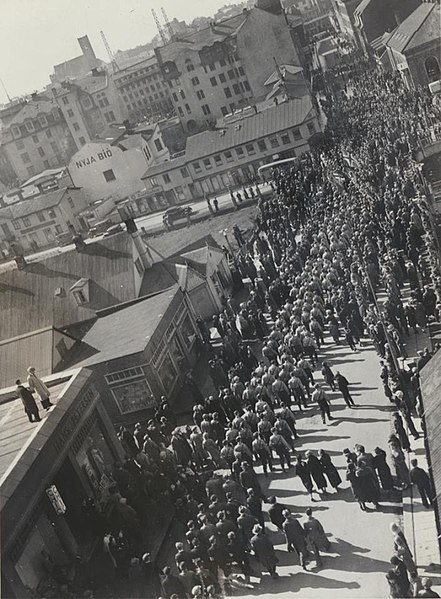
File:Nazi-march-Reykjavik-Iceland.jpg
By UnknownUnknown author [Public domain], via Wikimedia Commons
This evasion of choice leads the child from adolescence into a position Beauvoir calls the “sub-man.” This less than fully human figure seeks to hide from existence and maintain themselves in a prolonged deferral of choice. Of such people Beauvoir writes,

“They have eyes and ears, but from childhood on they make themselves blind and deaf, without love and without desire. This apathy manifests a fundamental fear in the face of the risks and tensions which [casting oneself into the world] implies.”

So as to avoid real choice, the “sub-man” opts for conformism. As we will see, in this sense he is in league with the “serious man.” Let us take the example of religious belief. The “serious” person believes – subjectively and passionately – in the dogma associated with their religion. They hold it as a transcendent value to which their freedom is subordinate. In contrast, the “sub-man” merely mouths the beliefs of those around him. After all, passionately committing oneself to beliefs entails choice and responsibility. Such a person is very dangerous, according to Beauvoir. As she writes,

“He realizes himself in the world as a blind uncontrolled force which anybody can get control of. In lynchings, in pogroms, in all the great bloody movements organized by the fanaticism of seriousness, movements where there is no risk. Those who do the actual dirty work are recruited from among the sub-men.”

“Sub-men” merely “go along,” deliberately relinquishing, or at least attempting to relinquish, their own freedom by immersing themselves in the vague impulses of the crowd. And, as the twentieth century showed all too clearly, the impulses of the crowd are often violent and murderous. The cause does not matter. The issuing authority, if there is one, does not matter. The sub-man is always “just following orders.”

Unlike the “sub-man” who apathetically chooses not to choose and, fleeing existence, adopts a posture of conformity, the “serious man” actively and passionately chooses values. However, in so doing this person simultaneously effaces their own subjectivity and freedom. They pretend that the values they have chosen are in fact objectively given and absolute, rather than the creations of human beings. Beauvoir explains,

“The serious man gets rid of his freedom by claiming to subordinate it to values which would be be unconditioned. He imagines that the accession to these values likewise permanently confers value upon himself.”

The serious person is, we may say, a true believer. If the “sub-man” merely goes along with values that he finds ready-made in the world, the “serious man” actively and passionately chooses them. If it is a matter of religion, the “serious man” is a fanatic. If it is a matter of country, the “serious man” is a patriot. If it is a matter of work, the “serious man” is a dedicated company man. Beauvoir thus quips,

“The thing that matters to the serious man is not so much the the nature of the object which he prefers to himself, but rather the fact of being able to lose himself in it.”

Having already set up values which now, again, appear as ready-made, the “serious man” no longer bears the burden and anguish of choice. The church, the state, the company – someone has already decided for him. Of course, the contradiction implied in this movement renders the “serious man” almost schizophrenic, constantly choosing in one moment only to deny the choice in the next. Beauvoir explains further,

“The serious man’s dishonesty issues from his being obliged ceaselessly to renew the denial of his freedom. He chooses to live in an infantile world, but to the child the values are really given. The serious man must mask the movement by which he gives them to himself, like the mythomaniac who while reading a love-letter pretends to forget that she has sent it to herself.”

Unlike the “sub-man,” the “serious man” has actively and passionately chosen. However, they too, in a sense, deny their own freedom. They do so, not through apathetic conformism, but rather by treating their values as objective and intrinsically value. Like the “sub-man” the “serious man” is dangerous. For such a person, the entire world, even their own life, appears but a means for some higher end, whether it is the glorification of God or protection of the country.

According to Beauvoir, seriousness may give way to nihilism. So, this is the next “form of consciousness” she presents. The nihilist is the person who determines that, since there are no objective values, there is no value at all. Such a person may be “undermined,” in the sense described by Camus, and then they are led to ask themselves “what’s the use in living?” They answer: There is none. To see how this occurs, we should follow Beauvoir’s discussion of seriousness. Let us imagine that Sally falls in love with Jane (to stick with a previous example), choosing Jane and their love as the value around which she organizes her life. Sally, we’ll say, is “serious” about their relationship in the sense that she believes it to be objectively and intrinsically meaningful and valuable. For Sally, everything else in the world is only meaningful or valuable relative to her relationship with Jane. Let us then imagine that Jane dies in an unexpected accident. What now? What can be the value or meaning in Sally’s life? Sally may conclude that there simply is none. Thus, Beauvoir writes,

“Nihilism is disappointed seriousness turned back upon itself.”

The nihilist wrongly believes that there is some external standard by which existence could be judged as meaningful or valuable. They then find that this standard has not been met, and therefore conclude that life has no meaning or value. In response, Beauvoir explains,

“The nihilist is right that the world possesses no justification and that he himself is nothing. But he forgets that it is up to him to justify the world and to make himself exist validly.”

The nihilist does not choose positive values for themselves, but merely rejects those they have found given. The nihilist does not positively define themselves through action and choice, but merely rejects any definition as valid. The nihilist asserts freedom, but only by denying it any positive content. For this very reason, however, their freedom takes the form of a will to destruction, rather than creation. This may manifest in suicide or it can take the form of an almost insatiable craving for violence – here, Beauvoir sees that the “seriousness” driving Nazism was also in league with a certain “partial nihilism.” Regardless, nihilism has seen the vanity and self-deception at the heart of the “serious,” but has wrongly concluded from this that all is meaningless.

The rejection of the values of the serious world has landed us in nihilism, but this is not the end of the story! As we will see going forward, this “highway of despair” leads to a form of consciousness that is able to passionately assert values while accepting that they are its own creations, reflecting only its own unique subjectivity.

Please feel to leave questions or comments!

Simone de Beauvoir on Existentialist Ethics

In this blog post, I will begin our discussion of Simone de Beauvoir’s The Ethics of Ambiguity. While Beauvoir is most famous for her work The Second Sex which made her the intellectual mother of “second wave” feminism, we will here be primarily concerned with her development of an existentialist ethics. For a very brief introduction to Beauvoir’s work as a feminist check here and here. It is worth making it clear, however, that Beauvoir’s feminism is an outgrowth of her existentialist ethics, and vice versa. To offer a somewhat too pithy summation: an existentialist ethics can only be a philosophy of liberation. Thus, Beauvoir famously writes, “To will oneself moral and to will oneself free are one and the same decision.”

By the time Beauvoir composed The Ethics of Ambiguity in 1947, many of the central doctrines and criticisms of existentialism were well known among intellectuals. Probably the most damning criticism made against existentialism was that it lacked a basis for an ethics. The existentialist preoccupation with themes of freedom, authenticity, and individuality seemed to come at the expense of any concern for others or respect for any standard of value. Further, as most existentialists were atheists, it seemed to many that the doctrine lacked any metaphysical basis for an ethics. Beauvoir set herself the task, not only of answering these critics, but moreover of demonstrating that existentialism is the only philosophical standpoint that can provide a basis for ethics: namely, the ambiguity of human existence. Thus, the title of the work.

File:Schiavonetti Soul leaving body 1808.jpg
By Luigi Schiavonetti (†1810) (Robert Blair: “The Grave, A Poem”. London 1808) [Public domain], via Wikimedia Commons
I have already mentioned Beauvoir’s use of the term “ambiguity” in our discussion of Sartre. Recall that human existence is, for Sartre, both facticity and transcendence. We find ourselves thrown into a world in which there are facts about ourselves which are simply given. For example, height, weight, country of origin, ethnicity, race, etc. These features of our existence are what Sartre refers to as our “facticity.” We all find ourselves in some factical situation. However, according to Sartre, we are not defined by our factical situation. Rather, we define ourselves through our choices and actions in response to that which is merely given; through our freedom we transcend facticity. Later, in The Second Sex, Beauvoir will write that “One is not born, but rather becomes, a woman.” Beauvoir was not denying the existence of biological sex (though it turns out to be a much more complex story than most people believe). Beauvoir’s point was that biological sex does not define what it means to be a woman; people do that through their choices and actions. We are both facticity and transcendence.

Unfortunately, according to Beauvoir, most philosophers of the past have sought to “mask” the ambiguity at the heart of human existence. They have done this largely by denying one or another side – treating the human as either pure transcendence or pure facticity. Even when philosophers have affirmed the duality of human existence, Beauvoir maintains, they have typically sought to elevate one aspect over the other. Either the human being is a pure mind for whom the world is merely a perception (as in idealism) or the human being is a purely physical being who is governed entirely by the laws of nature (as in materialism). In contrast to these views, Beauvoir writes,

“Let us try to assume our fundamental ambiguity. It is in the knowledge of the genuine conditions of our life that we must draw our strength to live and our reason for acting.”

The ethics of ambiguity will attempt to look human existence squarely in the face and base itself on the strange duality that it finds there.

File:San Moisè (Venice) Interno - Mosè colpisce la roccia - Soffitto.jpg
Niccolò Bambini [CC BY-SA 4.0 (https://creativecommons.org/licenses/by-sa/4.0)%5D, from Wikimedia Commons
As an atheist, Beauvoir follows Sartre’s idea that human existence is fundamentally contingent. We find ourselves here in the world, but there is no ultimate explanation or final reason for our existence. There is no “human nature” that can define us in advance. For this reason, Beauvoir rejects the very idea of an ethics based on an objective, external standard of value; some meaning which existence would have intrinsically. Rather, existence has value only because we give it value through our own choices and actions. As she writes,

“One can not [sic] start by saying that our earthly destiny has or has not importance, for it depends on us to give it importance. It is up to man to make it important to be a man, and he alone can feel his success or failure.”

There is no absolute standard by which one can judge the value and meaning of life. This is a consequence of the contingent nature of human existence. Even so, this does not mean that life is meaningless or without value; it simply means that whatever value or meaning life has comes from life itself.

In this respect, human existence is fundamentally tragic and doomed to failure. Despite our efforts, we can never be anything “in-itself,” to use Sartre’s language, and whatever values we put forward into the world will remain always and only values for us. Sartre therefore proclaims that “Man is a useless passion.” As we will see, there are many ways to respond to this failure, and most involve self-deception and bad faith. However, Beauvoir describes a person who has undergone existentialist “conversion,”

“He will understand that it is not a matter of being right in the eyes of a God, but of being right in his own eyes. Renouncing the thought of seeking the guarantee of his existence outside himself, he will also refuse to believe in unconditioned values which would set themselves up athwart his freedom like things.”

Our values do not have any external guarantee or justification. Like our lives, they are the result of pure contingency. But, this lack of external guarantee and justification does not mean that there is no justification. Instead, we must justify our lives and our values for ourselves, and we must do so in a world where those justifications are always offered to concrete others with whom we find ourselves. This project is doomed to failure, however, since no justification is eternal, absolute, or objective. Our lives are themselves then a continual project of justifying existence.

Ultimately, if there is to be an existentialist ethics it must not only affirm human freedom and human failure as facts, but also as goals. Another way of saying this is that, for Beauvoir, as for Sartre, existentialism is a fundamentally humanistic philosophical program. We are human beings and we are free. But we can and do will ourselves to be something more or other. In pretending to have found unconditional values, we attempt to be God – surreptitiously imagining our freedom as immediately creative and its creations as eternal, absolute, and objective. We subordinate ourselves and our freedom to our own lies. Beauvoir describes this as an attitude of “seriousness.” She writes,

“In the servitude of the serious, the original spontaneity strives to deny itself. It strives in vain, and meanwhile it then fails to fulfill itself as moral freedom.”

As we will discuss in much greater detail later, the serious person vainly worships false idols, believing that there are values that exist outside and beyond themselves. In contrast, Beauvoir writes,

“If man wishes to save his existence, as only he himself can do, his original spontaneity must be raised to the height of moral freedom by taking itself as an end through the disclosure of a particular content.”

Put less abstractly, I must self-consciously choose my own freedom. This choice must take the form of a sustained action carried out in the world. It can only be realized, therefore, through a concrete process of self-liberation. I must assert, demand, and carry out my own freedom and express it in the world through creative activity. And what I will for myself, I must will for all. As I said at the beginning, an existentialist ethics must be a philosophy of liberation.

Please feel free to leave comments and questions!

Martin Buber on the I-Thou Relation

In this blog post, I will continue the discussion of intersubjectivity which we began in the previous post on Sartre’s theory of our being for others. Today’s discussion takes a brief look at the work of the Austrian-Jewish philosopher Martin Buber. Buber is a fascinating figure and you can read more about his life here. For our purposes, however, it is unnecessary to focus on his biography. The important thing for us is to add greater depth to our understanding of our relations to others.

Our text is drawn from Buber’s most famous and very widely read work I and Thou, published in 1923. An important point to make, then, is that the ideas presented in this reading antedate and were influential in many of the other readings we’ve read so far. Another thing to notice is that the title is a translation of the German Ich und Du. Unlike contemporary English, German has both a formal and informal personal pronoun for the second-person address, those cases in English where we use the word “you.” Clearly, our translation has chosen the relatively archaic English word “thou” to suggest a more formal mode of address. There are probably some good reasons for doing so; however, the German “du” is the informal second-person pronoun. Thus, the title of the work might better be translated as “I and You.”

File:30b Sammlung Eybl USA James Montgomery Flagg (1877-1960) I want you for U.S. Army. 1917. 101 x 76 cm. (Coll..Nr. 3116).jpg
Eybl, Plakatmuseum Wien/Wikimedia Commons / Enter a caption

The title of the work names its central preoccupation very clearly: namely the relation between self and other, I and thou. For Buber, the I-Thou relation is only one of two fundamental relations we may bear to that which is outside of or other than ourselves. The other such relation is the “I-It” relation. Importantly, according to Buber, these relations are expressed in what he refers to as “founding words.” While we may not explicitly conceptualize or pay close attention to what is implied in our use of pronouns, Buber thinks that there are deep truths embedded in our language. He writes,

“Founding words do not signify things, but rather relations.
Founding words do not assert anything that would exist beyond them, but spoken, they ground an inventory of states of affairs [Bestand].”

Different forms of relation are signified in our use of the words “you” and “it.” Thus, the use of these words is less about the person or “object” referred to, and more about the relation we bear toward them. For this reason, Buber always treats these words as part of a word-pair: “I-Thou” or “I-It.” This shows that what is signified in the use of either pronoun is first and foremost the relation and not the person or “object.” When Buber writes that these words do not signify something that is beyond them, his point is that the use of the word is the act of taking up the relation toward whomever or whatever is referred to – they come together as a package. Moreover, as one can hopefully see, a great deal hinges on the relation that one takes toward that which is outside or other than oneself. After all, “objects” referred to by the word “it” are rarely accorded moral status.

Importantly, for Buber, there is no self that transcends the relations taken up toward things considered outside or other than oneself. Another way of saying this is that the self is a process of individuation and differentiation through which one establishes oneself in relation to and at a distance from other entities. Thus Buber proclaims,

“There is no I in itself, but only the I of the founding word I-Thou, and the I of the founding word I-It.”

Another way of saying this is that the self is less a given and substantial entity and more a relation or set of relations to entities which are outside or other than oneself. For Buber, we become ourselves through a process of individuation which involves differentiating and distancing  from other entities to which we relate ourselves. There is no “I” outside of relations to others.

Given that there are two founding words, I-Thou and I-It, there must then also be two primary ways of being a self, of undertaking the process of individuating ourselves and relating to others. The first way of being a self relates to other entities cognitively and strategically as “objects,” things it seeks to know and utilize. This posture toward other entities is perhaps best exemplified in the work of the philosopher Renes Descartes, whom we discussed previously in relation to the method of phenomenology. For Descartes, philosophy begins from the search for certain knowledge and it proceeds with the individual philosopher submitting the world around to doubt. Descartes claims to discover through this process that he is a res cogitans, a thinking thing. The world exists for this thinking thing as a mere idea, an experience or representation internal to itself. The thinking thing must scrutinize its experiences and representations and test them to ensure that it builds its edifice of knowledge on absolutely certain foundations. This self is a “subject” and the world it confronts is now “objectified,” each thing exists primarily to be categorized and explained. As Buber puts it,

“The human being who has become an I-ness, who utters I-It, takes a position over and against things, not as their counterpart in the current of reciprocity.”

This point may be made clearer and more concrete by considering the relationship that doctors have to patients. Doctors sometimes take up I-It relations by treating their patients as mere objects to be known, natural systems to be understood and explained according to the basic laws of biology. In doing so, they treat the bodies of their patients as machines, running diagnostics and ensuring proper functioning. Even if the patient is addressed with the word “you,” the doctor does so only strategically in order to achieve desired results – their relation to the patient is not fundamentally altered. In so doing, the doctor positions themselves as separate from the patient and above them, becoming an observer and “mechanic.” The patient is for them only one more in a long line, a member of the biological species homo sapiens and a source of new knowledge and increased revenue. Such is the I-It relation

File:Ghanaian Medical Doctors – Ward rounds at Komfo Anokye Teaching Hospital, Kumasi, Ghana.jpg
By Photographer – Cary Engleberg (OER Africa) [CC BY 2.0 (https://creativecommons.org/licenses/by/2.0)%5D, via Wikimedia Commons
What of the I-Thou relation? Importantly, for Buber, the I-Thou relation is not cognitive or strategic. I do not know or use, but rather I “encounter” or “meet” the other. In the encounter, the other appears before me a singular individual and I recognize, to use Sartre’s phrase, that I am present “for the other.” Moreover, the encounter involves my whole being, not just the intellect. I stand before the other and am fully present to them, though of course this may be precisely the reason that I seek to cover or hide myself. Buber explains,

“The founding word I-Thou can only be uttered with one’s whole essence. Gathering and fusing them into a whole essence can never happen through me, can never happen without me. Meeting the Thou, I become. In the process of becoming the I, I utter Thou.
All real life is encounter.”

We could again refer to the doctor example, however, I think it may be more useful to consider a first date. The person who seeks to know their date objectively and merely to use them is really a predator. In contrast, generally the date must be an “encounter” – however well or badly that may go. Each person appears to the other as a singular individual and becomes themselves in the presence of the other and vice versa, adopting a relation which encompasses their whole being and defines the situation. Each is attuned to the relation bodily (as expressed in unconscious body language), emotionally (obviously), and intellectually (though now the intellect plays a role within an integrated whole, rather than separating itself off and lording itself over the body and emotions).  Perhaps in this relation they feel “chemistry” and are delivered back into themselves. Or perhaps things don’t quite work out and each feels “awkward” about the relation. In any case, what is clear is that the I-Thou relation is all-encompassing and defines the situation of their meeting.

According to Buber, the I-Thou relation is not limited only to other human beings. It occurs, in fact, in three spheres. First, we may encounter other non-human entities in nature in I-Thou relations. This occurs most obviously with beloved pets and animals, but may also occur, Buber thinks, between human beings and other natural entities. In such moments, I may feel myself in the presence, say, of this river and find it most appropriate to address it directly as “you.” Above this, of course, there is the encounter with other human beings. Here, the “I-Thou” relation comes to language most naturally and it must be emphasized that we always live our lives in relation to human others, both living and dead. Finally, Buber thinks, we encounter spiritual beings. As he explains,

“Here the relating is shrouded in clouds, yet revealing itself, without language, yet language-engendering. We perceive no Thou and still feel called upon, we answer – forming, thinking, acting: with our essence we utter the founding word, unable to say Thou with out mouths.”

Much as we may find ourselves called upon to address the river as an other and feel ourselves in its presence, so too we find ourselves in the presence of unseen spiritual others, to whom we address ourselves through prayer and sacrifice. In all cases, we stand before the other exposed in our wholeness, becoming ourselves only in the relation. And, ultimately, according to Buber, in each genuine encounter we likewise encounter and stand before God, the Eternal Thou.

On the basis of this distinction between I-Thou and I-It relations, Buber is able to develop a critique of modernity as a “sick age” as he puts it. In such an age, according to Buber, I-It relations come to prevail over and dominate I-Thou relations. Individuals thus come to be understood as cogs in a great machine whose actions are determined by causes independent of themselves.  In such a time, Buber writes,

“…the It-world is no longer infused with and made fertile by the influx of the Thou-world, as if by living streams: cut off and stagnant, a gigantic swamp phantom, it overpowers humans. As they settle themselves within a world of objects that no longer become presences to them, they succumb to it. Then, familiar causality increases to the oppressive, suffocating level of ordained fate.”

At one and the same time, having established themselves as lords over an “It-world,” human beings come to see themselves as “objects” which behave and must be manipulated according to the laws of such a world. They feel themselves alienated and cosmically “homeless,” exiled from a “Thou-world” in which they might truly encounter others. Their relations to nature, to other human beings, and to the spiritual world beyond their senses become merely cognitive and strategic. With respect to such an age, Buber warns,

“And in all of truth’s seriousness, [let me tell] you: Without It, the human being cannot live. But whoever lives with It alone, is not human.

As I-It relations come to dominate, as human beings relate to everything and everyone around themselves as mere objects, they find themselves increasingly alone in an inhuman world.

For Buber, there is no way to exist meaningfully, to truly be oneself, outside the genuine encounter, truly meeting, with the other.

Please feel free to leave comments and questions!

Jean-Paul Sartre on Being with Others

In this blog post, I will be completing our discussion of Jean-Paul Sartre with a look at his treatment of the the relationships we bear to one another, what philosophers might refer to as our intersubjective relations. Notoriously, Sartre has the character Garcin announce in his play No Exit that “Hell is — other people.” This may seem like a pessimistic overstatement. However, Sartre argues on the basis of his larger philosophical project that human relationships are ineradicably fraught with conflict and struggle.

File:No Exit, Jean Paul Sartre (Κεκλεισμένων των θυρών, Ζαν Πολ Σαρτρ).jpg
By KsKal [CC BY-SA 3.0 (https://creativecommons.org/licenses/by-sa/3.0) or CC BY-SA 3.0 (https://creativecommons.org/licenses/by-sa/3.0)%5D, from Wikimedia Commons
Sartre’s discussion of our relationships with others draws heavily on two primary influences. The first influence is Heidegger’s discussion of Dasein as “being-with” (mitsein). The second is G.W.F. Hegel’s famous theory of the “master-slave dialectic.” For Heidegger, each of us is a Dasein – that is, we are the kind of being for whom being is an issue. We only ever confront the question of being, however, within a concrete historical world. And, Heidegger emphasizes, we always do so alongside and with others for whom being is also an issue. Thus, human existence is always a matter of “being-with.” For the most part, our being with others takes the form of “falling” into the public interpretation of the world produced and sustained by the anonymous “they.” This way of “being-with” seeks to disburden us of the responsibility of answering the question, “Who am I?” The question can be answered for each of us without a second thought because the answer is already supplied to us ready-made through the interpretation of the “They.” I am whoever “they” say I am. Heidegger offers an all-too-brief analysis of the possibility of an authentic way of being with others. It’s difficult to gather much from his written remarks in Being and Time and elsewhere (though this has not stopped scholars from trying). However, what we can say is that it must take the form of releasing the others with whom we find ourselves to their own existential solitude in the anxious anticipation of death.

File:Blow for Blow., ca. 1863 (5573998949).jpg
By Library Company of Philadelphia [No restrictions], via Wikimedia Commons
In contrast to Heidegger’s account, which focuses on the nebulous power – Heidegger even uses the word “dictatorship” – of the public interpretation of the world, Hegel focuses much more directly on the concrete interaction between self-conscious beings. According to Hegel, when two self-conscious beings confront one another, each demands to be “recognized” by the other. That is, each demands that the other treat them as more than an “object” of perception and desire; each wants to be treated as a free, self-conscious being in its own right. According to Hegel, even as each side demands recognition from the other, they also both seek to submit the other side to their will. I say to you: “You are an object for me, a piece of the furniture of my world. You must recognize and submit to my will.” And you say the same thing right back. There is thus conflict. In fact, Hegel believes, this “struggle for recognition” must escalate to a fight to the death, as each side must be willing to stake their life on their freedom. Though it is only one moment in a much longer story, according to Hegel, this conflict will initially result in the death or enslavement of one or another of the two parties.

In my previous post, I introduced some of Sartre’s important terminology. As I discussed there, I experience the world as it appears “for me;” that is, I perceive the world from my own perspective and in relation to my own consciousness. Nonetheless, I also posit that the objects of my experience have an existence “in-themselves.” That is, I experience objects as having an independent existence that transcends any particular perception I may have of them. In contrast to other things in the world, however, my consciousness does not appear as an object and has no independent existence beyond its appearance for me. I am self-conscious certainly, but my self-consciousness does not take the form of perceiving an “external” entity separate from myself. Thus, Sartre distinguishes consciousness as the “for-itself” from other entities which he refers to collectively as the “in-itself.” So far, however, this account imagines that I am alone in the world. Once we introduce other self-conscious beings, the picture becomes much more complicated. Now, I appear not only to myself, but also to others – I am an object “for-others.” Worse yet, I am aware of myself as “being-for-others” – the phenomenon we typically refer to in everyday English as being “self-conscious.”

Sartre conceptualizes my being-for-others in terms of what he calls the “look” or “gaze” (le regard) of the other. In the look of the other, I appear both as an object with an independent existence “in-itself” and as a self-consciousness, though here in the form of a disconcerting “absence.” That I am aware of the look of the other and myself as being-for-others is perhaps most easily demonstrated in the phenomenon of shame or embarrassment at my nakedness. If, for example, I realize that, unbeknownst to me, there is another person staring at me as I change clothes, I will immediately seek to cover myself and hide from their gaze. In this way, Sartre says, the look of the other “fixes” or “possesses” me. That is, whereas for myself I remain a nothingness and infinite project, others determine who and what I am as I appear to them. The freedom and ease of my solitary nakedness is interrupted by another and, suddenly, I feel ashamed and embarrassed of myself – I am not only a self-consciousness but an object for the other. Thus, I not only cover myself to obstruct the gaze of the other, but actually wear clothes by which I seek to win their recognition and approval. And, of course, whatever the interpretation they have of me, others cannot help but frame me according to a description and evaluation which is not my own. To you, for example, I may appear as a “professor” and you determine my being in terms of this role. Yet, in my own self-consciousness, I transcend this, indeed any, role.

Unfortunately, I cannot help but seek the recognition and approval of others. The other contains, as Sartre will put it elsewhere, the “secret of what I am.” In one sense, I appear to the other only as a body, an object. My thoughts and feelings, my consciousness, remain trapped in a solitary privacy which I cannot escape. So, I seek to express myself and externalize my self-conscious existence in the world. My “expressions” are in themselves, however, mere facts which fall lifeless into the world – unless there are others there, I might as well be screaming into the void. But there are others and, through my expressions, I present myself to them. Sartre explains,

“When Pierre locks [sic] at me, I know of course that he is looking at me. His eyes, things in the world, are fixed on my body, a thing in the world – that is the objective fact of which I can say: it is. But it is also a fact in the world. The meaning of this look is not a fact in the world, and this is what makes me uncomfortable. Although I make smiles, promises, threats, nothing can get hold of the approbation I seek; I know that it is always beyond.”

Through the recognition of the other, my consciousness may be validated and have a public existence in the world. But, of course, this fact leaves me “uncomfortable” since my being lies in the hands of the other. If I tell the person who is staring at me to leave, my command must be recognized and assented to if it is to have any force. Otherwise, there’s a fight.

File:By the exchanging of rings (8014548515).jpg
By dannipenguin [CC BY-SA 2.0 (https://creativecommons.org/licenses/by-sa/2.0)%5D, via Wikimedia Commons
Indeed, for Sartre, there are two “primitive attitudes” we may thus take toward the other – each of which, sadly, is doomed to failure. The first attitude, he claims, involves an attempt on my part to treat the other as a mere object, thereby freeing myself from the gaze of the other. The second attitude, in contrast, seeks to “assimilate” the freedom of the other into my own, to transform the other into a mere extension of myself. In the first attitude, whether literally or figuratively, I seek the death of the other. In the second, I seek their enslavement. Let us consider the case of love. Say that Sally loves Jane. Sally wants to express her love to Jane so that it may be recognized and, hopefully, reciprocated. However, obviously, this is a difficult thing to do. Jane may not reciprocate or she may misunderstand or misinterpret Sally. Jane now has the power to decide the meaning of Sally’s love and, therefore, who and what Sally is. For Sally, then, Jane’s freedom is both needed, her love can only be validated by Jane’s free recognition and reciprocation, and despised, since Jane’s freedom is now the uncertain power by which the very meaning of Sally’s actions will be determined. Moreover, clearly Jane is in much the same position, regardless of what she feels. Her evaluation of the situation – her subjective perception and desires – can only be validated and rendered meaningful through the recognition and reaction of Sally.

What to do? How to proceed? One option, as Hegel suggests, is to seek the enslavement of the other. If she has no choice, then Jane must accept and reciprocate Sally’s love. Of course, this attempt to “assimilate” and “incorporate” Jane’s will into Sally’s cannot succeed. Not only for the obvious reason that Jane will most likely resist it, but also because it destroys the very possibility of free recognition through which Sally’s love could be recognized and reciprocated. If Sally is successful, then, as before, she is basically alone in the world, screaming into the void. Jane might as well be a toy or a machine, as she can only parrot and play act whatever emotions and phrases she has been forced to. Alternatively, Sally may seek Jane’s death. Having killed Jane, Sally’s love is now no longer subject to Jane’s “look” – Sally need never feel “self-conscious,” ashamed, or rejected by Jane. But here again, Sally is left alone and her thoughts, feelings, and desires are once more re-absorbed into the nullity of her consciousness. Sartre explains,

“By virtue of consciousness the Other is simultaneously the one who has stolen my being from me and the one who causes ‘there to be’ a being which is my being.”

This is the basic condition of being with others, according to Sartre. It is by its nature paradoxical and full of conflict. I need the other to recognize my freedom if it is to have any independent existence in the world as a being in-itself. Yet, precisely this need subordinates my freedom to that of the other. As Sartre will put it, I am responsible for my being, but I cannot be the foundation of my being – the other remains this foundation. I can take over this foundation only by killing or enslaving the other. Paradoxically, though, this effort is doomed to failure. In either case, I am once again reduced to nothingness.

Overstated pessimism? Possibly. Probably! But it’s hard to deny that much of our lives are spent searching for recognition from others – or that we frequently resent the power of others to determine who and what we are or must do.

Please feel free to leave comments and questions!